Creating a safe and engaging indoor play area requires more than simply filling a facility with colorful structures. Every component must be carefully selected, designed, installed, and maintained to support children’s physical activity while reducing potential hazards. A reliable soft play equipment manufacturer plays an important role in this process by combining safety principles, durable materials, creative designs, and practical engineering. Whether the facility is a family entertainment center, shopping mall, daycare, school, or recreational venue, thoughtful planning can create an environment where children can play confidently and comfortably.
Understanding the Role of a Soft Play Equipment Manufacturer
A professional soft play equipment manufacturer does much more than produce individual play structures. Manufacturers typically work with facility owners and designers to develop equipment based on available space, target age groups, expected visitor numbers, and the desired theme. This approach allows the play area to be designed as a complete environment rather than as a collection of unrelated pieces.
Experienced manufacturers can provide climbing structures, tunnels, slides, ball pools, obstacle elements, interactive activities, and other components. They can also help determine how different activities should be arranged to encourage movement while maintaining clear pathways for supervision.
The design process should begin with an assessment of the facility. Ceiling height, floor dimensions, entrances, emergency exits, columns, ventilation, lighting, and other building characteristics can affect the final layout. Proper planning helps prevent overcrowding and provides staff with better visibility throughout the play area.
Prioritizing Safety During Equipment Design
Safety should be incorporated into every stage of indoor playground development. A quality manufacturer considers potential impact points, entrapment risks, sharp edges, structural stability, fall zones, and accessibility when developing equipment.
Soft surfaces are particularly important because children may fall while climbing, jumping, or navigating obstacles. Padding should be appropriately selected and securely installed to reduce the severity of accidental impacts. Protective materials should also be durable enough to withstand frequent use without quickly tearing, compressing, or exposing internal components.
Equipment should be designed according to the intended age and ability of users. Younger children require different challenges and protective features than older children. Separating play zones by age group can reduce collisions between children with significantly different sizes, speeds, and physical abilities.
Selecting Durable Materials
Indoor play equipment experiences continuous use, making material quality an important consideration. A manufacturer should select materials that can withstand repeated climbing, sliding, jumping, and contact without compromising structural integrity.
High-quality foam, protective padding, coated steel, durable plastics, and wear-resistant coverings can contribute to longer equipment life. Surfaces should also be relatively easy to clean because indoor play environments experience frequent contact with hands, shoes, and other sources of dirt.
Materials should be selected with maintenance in mind. If a covering becomes damaged, replacement should be practical. Modular construction can make it easier for operators to replace individual components instead of removing an entire structure.
Designing for Visibility and Supervision
Even the safest equipment can become difficult to manage if staff cannot see children clearly. An effective indoor play area should therefore provide good visibility from multiple positions.
Manufacturers can design structures with open sightlines, strategically positioned platforms, transparent panels, and appropriately sized openings. Play zones should avoid unnecessary blind corners where children could become difficult to monitor.
The arrangement of equipment is equally important. Slides, climbing features, tunnels, and interactive sections should be positioned so that staff can identify unusual behavior or potential problems quickly. Good visibility also helps parents feel more comfortable while their children are playing.
Creating Age-Appropriate Play Zones
Children at different developmental stages have different physical capabilities and play preferences. A successful indoor facility can include separate areas for toddlers, younger children, and more active older users.
Toddler areas can feature low-height climbing elements, soft blocks, gentle slides, sensory activities, and simple interactive components. Older children may prefer larger climbing challenges, tunnels, bridges, obstacle courses, and faster slides.
Age separation does not mean that every zone needs to look completely different. A cohesive theme can connect the facility while different equipment configurations provide suitable levels of challenge.
Integrating Movement and Interactive Activities
Indoor play areas should encourage children to move rather than simply occupy space. Climbing, crawling, balancing, jumping, sliding, and navigating obstacles can make the experience more dynamic.
Interactive features can add another dimension to the environment. Touch-sensitive games, activity panels, sensory walls, and interactive challenges can encourage children to explore and solve problems while remaining physically active.
When developing a larger entertainment venue, operators may also consider complementary attractions. For facilities that include trampolines, carefully selected commercial trampoline park equipment can create additional opportunities for jumping and active recreation. However, trampoline zones should be planned separately from soft play areas where appropriate, with clear boundaries and suitable supervision.
Planning Efficient Use of Space
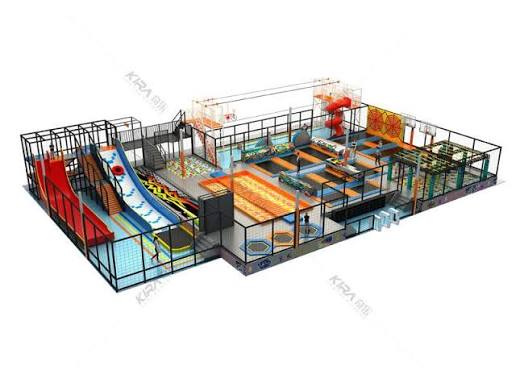
Indoor facilities often have limited floor area, so every square meter should serve a purpose. A manufacturer can help maximize available space by creating multi-level structures and incorporating several activities into a single design.
For example, a climbing section might connect to a tunnel, which leads to a slide and then into an open activity area. This creates a continuous play route without requiring separate floor space for every attraction.
At the same time, designers should avoid excessive density. Children need sufficient room to move safely, and staff require access for supervision, cleaning, and emergency response.
Considering Hygiene and Maintenance
Cleanliness is an essential part of a safe indoor play environment. Equipment should be designed so that frequently touched surfaces can be cleaned efficiently. Areas that collect dust, debris, or moisture should be accessible during routine maintenance.
Operators should establish regular inspection schedules. Staff can check padding, fasteners, coverings, ropes, platforms, slides, and other components for signs of wear. Small problems should be addressed promptly before they become larger safety concerns.
Manufacturers can support operators by providing maintenance instructions, replacement components, and guidance on cleaning procedures. Clear documentation makes it easier for facility managers to establish consistent maintenance routines.
Installation and Quality Control
Professional installation is another important part of indoor playground safety. Even well-designed equipment can present problems if components are incorrectly assembled or inadequately secured.
The installation process should follow the manufacturer’s specifications and applicable safety requirements. Structural connections should be checked carefully, and the finished installation should be inspected before the facility opens to the public.
Quality control should continue after installation. Regular inspections can identify loose components, worn surfaces, damaged padding, or other issues caused by intensive use.
Designing an Engaging Environment
Safety does not mean sacrificing creativity. A well-designed play area can combine protective features with imaginative themes. Forest adventures, castles, space exploration, underwater worlds, transportation themes, and colorful abstract designs can all encourage children to engage with the environment.
The strongest designs often use the physical layout to support the theme. A themed tunnel, climbing tower, bridge, and slide can create a sense of exploration while providing different forms of physical activity.
A professional soft play equipment manufacturer can help transform an ordinary indoor space into an environment that feels memorable while maintaining practical safety requirements.
Building a Safer Long-Term Investment
Choosing indoor playground equipment should be viewed as a long-term investment rather than a one-time purchase. Durable construction, thoughtful design, easy maintenance, and professional support can influence operating costs and customer satisfaction over time.
Facility owners should evaluate manufacturers based on product quality, customization capabilities, installation support, documentation, replacement services, and experience with comparable projects. A low initial price does not necessarily represent the best overall value if equipment requires frequent repairs or replacement.
By combining careful planning, appropriate materials, effective supervision, regular maintenance, and engaging designs, indoor play facilities can provide children with exciting opportunities for active recreation. Working with an experienced manufacturer helps ensure that safety and enjoyment are considered together from the earliest design stage through long-term operation.